
- by sedlv
- August 31, 2026
By Ross Youngs,
August 31, 2026
The Ghost Genome: Mapping a Constrained Chemical Execution Layer of Human Biology
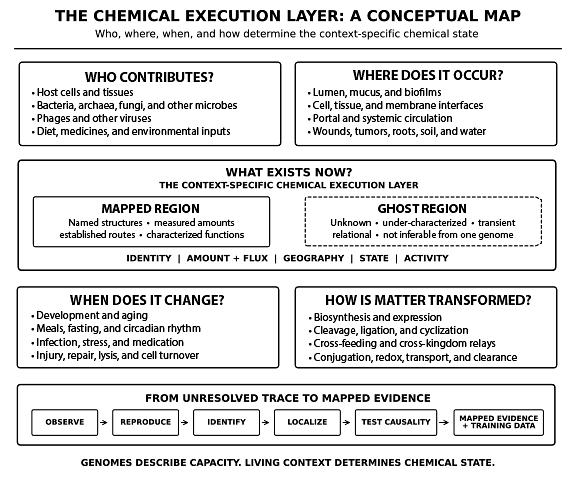
Abstract
Genomics maps biological capacity but does not directly report the real-time chemistry produced when host and microbial genes, viruses, diet, medicines, anatomy, environment, and time interact. Here, the ghost genome is a temporary working name for the unknown or under-characterized portion of this chemical execution layer—not a second chromosome. A ghost is an unresolved trace: once identity, exposure, function, and causality are adequately established, the label should be retired and the evidence made available to other laboratories and provenance-rich models. At a particular site and moment, realized chemistry is constrained by substrates, expression, ecological interactions, geography, transport, and clearance, although the cumulative repertoire across populations and contexts may be large. This perspective separates established host–microbial co-metabolism from hypotheses about distributed assembly, biologically realized priors, discovery productivity, and nature-like polypharmacology by design. The near-term requirement is an observatory that preserves who contributed the chemistry, where and when it appeared, and how matter was transformed. For global health, that observatory must include representative populations and local ecologies, use common confidence standards, and connect unresolved activity to causal chemistry, sustainable manufacture, delivery, and public trust.