Direct Access Microbial Dark Matter for AI-Driven Polypharmacology Drug Discovery
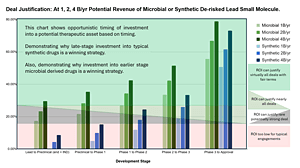
Summary – The pharmaceutical industry is currently trapped by two opposing forces—the saturation of common natural scaffolds and the infinite dilution of synthetic libraries—which collectively drive Eroom’s Law and push the cost of discovery to unsustainable levels. Our strategy reverses this trend by deploying a hybrid model that mines the “dark matter of biology”—the vast, unexplored chemical grammars hidden in rare biomes—to serve as the structural priors for AI-driven design. By decoding these evolutionary rules first, we effectively bypass the high failure rates of random synthetic screening, ensuring that our earliest preclinical candidates already possess the “bilingual” capacity to satisfy both therapeutic targets and biological safety constraints. This approach front loads value creation, shifting the investment opportunity to the earliest preclinical stage where the de risking occurs, thereby securing the highest possible ROI as envisioned by our Proof of Concept WL-Portfolio asset.
Summary – In this powerful and reflective episode, Ross shares how his journey through biology, genetics, engineering, and leadership has come full circle with purpose. Drawing from science, nature, and lived experience, Ross explores why strong, grounded male leadership still matters, the importance of mentorship and psychological safety, and how every phase of life prepares us for the work we’re meant to do. This conversation is a reminder that real progress—whether in innovation or leadership comes from balance, courage, and learning from those who have walked the path before us.
Summary – In this episode of Monetizing Innovation, we sit down with Ross Youngs, CEO and Founder of Biosortia, to explore a breakthrough at the intersection of microbiomes, AI-driven discovery, and scalable innovation.
Ross shares how Biosortia is unlocking previously unobtainable, drug-like small molecules directly from microbiomes—transforming how therapeutics, agrochemicals, longevity science, and life sciences approach discovery and de-risking.
We discuss why scale is the real innovation advantage, how accessing the “hidden chemistry of life” changes the economics of drug discovery by orders of magnitude, and what it takes to turn deep science into partner-ready IP with complete AI datasets.
A must-listen for founders, investors, and innovation leaders navigating the future of biotech, AI, and monetizable science.
By Ross Youngs, November 26, 2025. Microbiome Metabolic Fingerprinting: The Critical Control Layer for Deep Space Survival and Terrestrial Health (D2) The two defining challenges of the coming century—reversing the decline in pharmaceutical R&D productivity on Earth and enabling sustainable human habitation in space—are usually treated as separate problems. In reality, they share a common dependency: access to and control over
Adaptive signs deal with Pfizer worth up to $890 million for rheumatoid arthritis research (Dec 15, 2025) by Reuters. Adaptive said it will earn up to $890 million for the rheumatoid arthritis asset, including upfront fees and milestone payments tied to research progress, product development, and sales. Pfizer will use Adaptive’s technology to analyze immune cells from rheumatoid arthritis patients
Novartis pens $1.7B immuno-dermatology pact with AI-enabled British biotech (Dec 9, 2025) by James Waldron . What we do know is that Novartis will hand over $55 million, spread across an upfront cash payment, an equity investment and additional R&D funding. Down the line, Relation is eligible to receive preclinical, development, regulatory and commercial sales milestones that could reach $1.7